

I support 3 organizations: Joyce Meyer Ministries; Braille Without Borders; and World Vision. here is a little about Braille Without Borders. Its a fabulous organization!
HISTORY
In the summer of 1997 Sabriye Tenberken, blind herself, travelled within the T.A.R to investigate the possibility of providing training for Tibetan blind and visually impaired people. Sabriye realised there were no programs educating and rehabilitating blind people within the T.A.R. She then took the initiative to found the present project. For the start of the project she received help from a local school in Lhasa which provided space. A local counterpart took care of all the official paperwork.
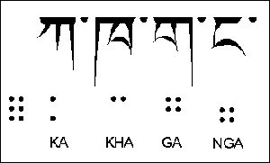 Part of the Tibetan Braille script developed by Sabriye Tenberken in 1992 at the Friedrich-Willhelms University, bonn, 1992. | Initially for her own use in her study of Tibetology at Bonn university, Sabriye developed a Tibetan script for the blind. This script combines the principles of the Braille system with the special features of the Tibetan syllable-based script. This script for the blind was submitted for close examination to an eminent Tibetan scholar, who found it to be readily understandable, simple, and easy to learn. As Tibetans until now had had no script for the blind, he suggested to Sabriye that she let blind Tibetans take use of it. |
First step: preparatory school for blind children
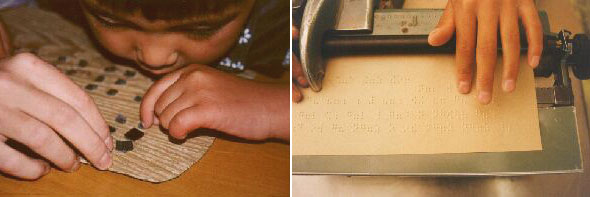
In May 1998 Sabriye Tenberken (German) and Paul Kronenberg (Dutch) left Europe to establish the Rehabilitation and Training Centre for the Blind, Tibet, starting with the preparatory school for elementary school children. After arranging all the necessary requirements, 6 children were collected from different villages to board at the school. The children came from different parts of the Tibet Autonomous Region and had to get used to each other's dialects. A local teacher was found and within a couple of days she was instructed in the Tibetan Braille script. The children learned the Tibetan Braille alphabet on wooden boards with Velcro dots. They worked with amazing enthusiasm and within just 6 weeks they knew all the 30 Tibetan characters and were able to count in three different languages (Tibetan, Chinese and English).
background information on some of the children
Tenzin
Tenzin is 14 years old. He comes from a little village within the Lhasa district. His parents are divorced, and he lives with his mother and his little brother. Tenzin belongs to the few blind children who were reasonably well integrated in his village. He has friends and had some tasks. While his friends were attending school he took care of the village yaks and goats. Through Medicines Sans Frontiers (MSF) Tenzin heard about the Project for the Blind, Tibet. He wasn't used to washing every day and the MSF-hygiene-trainers told him as a joke that only clean blind children could attend this school. Ever since he obeyed the hygienic instructions to wash daily. He was very eager to attend the school. Tenzin is a very social and intelligent child, who after only a few months learned to read and write the Tibetan, Chinese and English Braillescripts fluently. When we asked him about future profession plans, his answer was that he wants to study and he wants to learn massage and physiotherapy. He started in this class in 2001.
Norbu
Norbu is 14 years old. He comes from a very remote little farming village close to Shigatse. He has a little vision on his left eye, but not enough to attend a regular school. Norbu is very playful and likes ball games or just to run around. He is a fast learner and makes friends with other children very easily. Norbu was trained in making cheese and is now working as a trainer in the cheese factory.
Yudon
Yudon is 14 years old. She comes from a farming village close to Lhasa. Being the youngest of six sisters and brothers she is very independent in learning and playing. Yudon wants to become a teacher. In October this year she was integrated into a regular school.
Chile
Chile is 13 years old. He comes from a village in the Drigung area, about 130 km north east of Lhasa. His parents are poor peasants. He has one younger sister and within the village he has a lot of friends. He is the comedian of the school and he loves to sing too. He entertains everyone around him at all times, in all activities. younger sister and within the village he has a lot of friends. He is the comedian of the school and he loves to sing too. He entertains everyone around him at all times, in all activities. He has been trained in the music class was integrated in his village in the Oct 2003.
Metoq
Metoq is 15 years old and the oldest in the class. One day when she was 8, she was playing in the fields with some friends when they found a grenade. While playing withit, it exploded and she lost pretty much all her eyesight. With the help of glasses she sees a little, but not enough to attend a regular school. Her parents live north of Lhasa. Metoq is the leader of the schoolclass. Early in the morning before classes officially start, she lines up the other children and exercises the Tibetan Alphabet. She is very neat and she is a great help for the housemother and father. Tenzin Metoq was integrated in her home in Oct 2003. She wants to start a shop together with her mother.
Staff of the training centre
- A housemother and a housefather and a gatekeeper are employed.
They take care of the children at all times, except when the children attend classes. - A cook prepares all the meals for the children and the staff.
- Three teachers have been trained by Sabriye Tenberken to teach the children the Tibetan, Chinese and English Braille systems, and in addition they also teach mathematics, orientation and daily living skills. An additional English-teacher has been employed. He became blind through an accident and was trained by the first three teachers.
- In autumn 2000 two blind massage trainers started the massage and physiotherapy-training with two students. These students now teach in the BWB centre.
- Since March 2001 a famous blind musician took over the music-classes. He is training 4 talented students to become professional singers.
- In 2002 one staffmember has been employed to pruduce Braille school books.
Leisure time
- The children love to play ball games. The ball is filled with a few rice grains or a small bell, so the children hear where the ball is.
- Sculpturing tsampa is a very important way of training the sensitivity of fingertips and hands. Tsampa is the main traditional food in Tibet, it is made out of roasted barley mixed with yak butter. It is also often used as a material to mould sculptures.
- All of the children love to sing and dance. Now they have also discovered the fun of playing musical instruments, such as drums, flutes and bells. Apparently any instrument that produces a lot of noise is welcome.
- The children regularly paint.
- The children like to write stories and like to play theatre plays.


No comments:
Post a Comment